MERIS Images : Africa
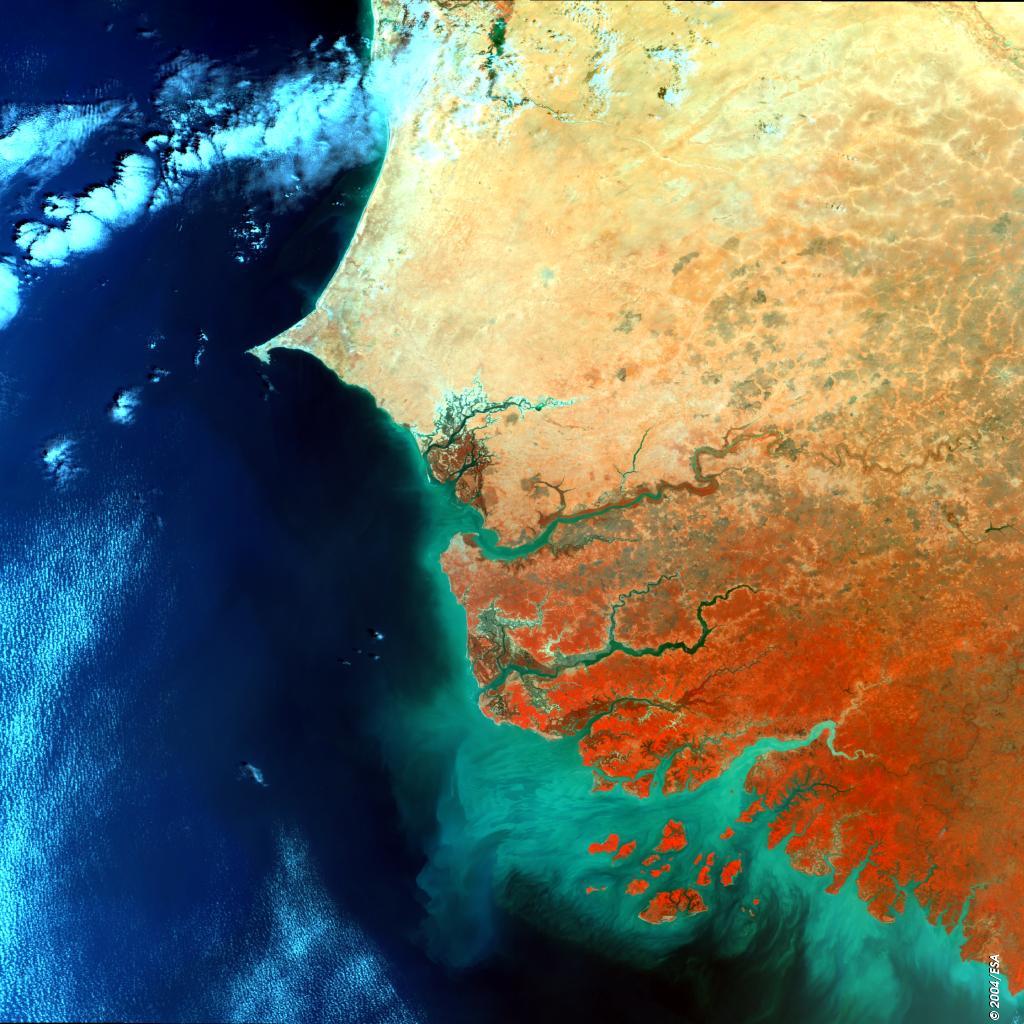 The Bijagos Archipelago is located off the Guinea-Bissau coast. The green colour of the sea around the islands is the result of sediments which are transported and deposited by the River Ge'ba. To the north of the image, in Senegal, the Cape Verde peninsula can be seen clearly. The peninsula has a peculiar "hook-like" shape and forms the westernmost part of Africa. It is about 32 km long and, at its maximum, 11 km wide. The capital Dakar lies on Cape Almadies, the western tip of the peninsula |
 This MERIS false colour image displays the East African island of Madagascar, the Comoros Islands can also be seen to the North West just poking through the clouds. The spectral bands have been chosen to highlight the different types of vegetation on the island. The bright yellow in the east and the north represents the extent of the tropical rain forest. The more red tones in the middle represent more highland areas, with the capital Antananarivo near the centre of the island can be found. To the west of the island the green tones represent deciduous forest. |
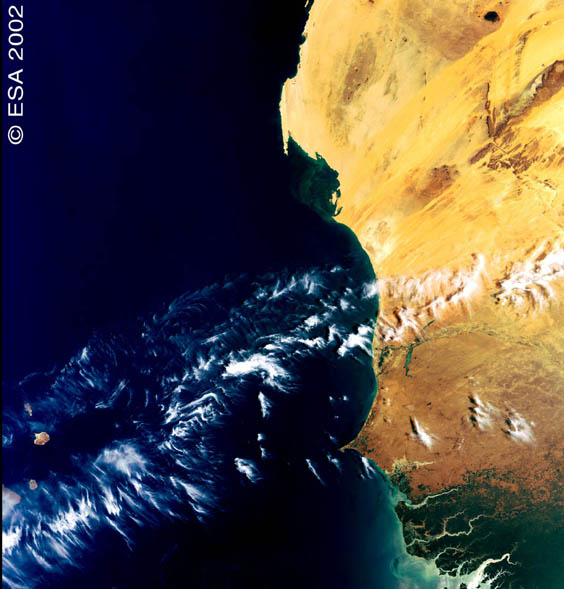 The first MERIS observation has captured the huge phytoplankton patch produced by the "upwelling" mechanism along the Mauritanian coast. The unprecedented resolution allows fine scale structures to be detected. In such upwelling areas north-east trade winds bring deep and nutrient-rich water to the surface, feeding phytoplankton.
|
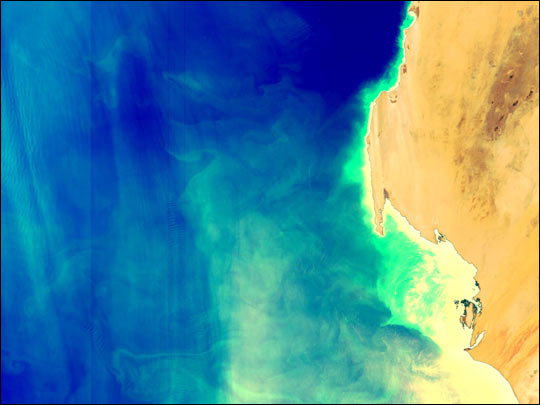 Just off the coast of West Africa, persistent northeasterly trade winds often churn up deep ocean water. When the nutrients in these deep waters reach the ocean's surface, they often give rise to large blooms of phytoplankton. This image of the Mauritanian coast shows swirls of phytoplankton fed by the upwelling of nutrient-rich water. |